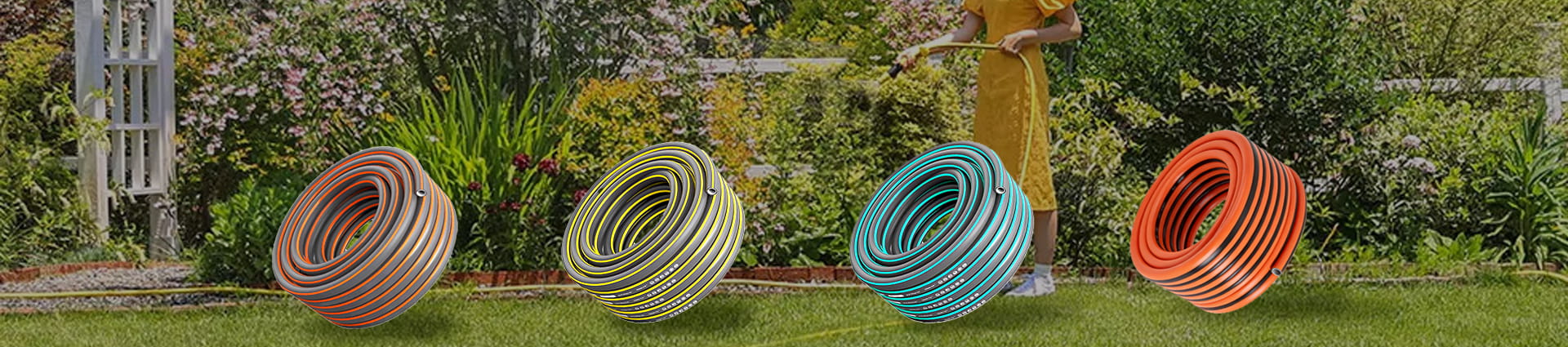
A Garden Hose reel should be used by connecting its inlet hose to the water source, unwinding only the length required, opening the faucet gradually, and keeping the hose free from sharp bends. After use, close the water, release pressure, drain the hose, and rewind it evenly.
Correct operation reduces kinks, connector stress, uncontrolled tangles, and premature hose wear.
Garden hose reels are available in several forms.
Wall-mounted manual reel
The user turns a crank to wind the hose onto a fixed drum.
Retractable wall-mounted reel
An internal spring rewinds the hose after the user gives it a controlled pull.
Portable reel cart
The reel is installed on a frame with wheels or a carrying handle.
Freestanding reel
The unit rests on the ground and can be moved between watering areas.
Open hose hanger
This is a simpler storage support rather than a rotating reel.
Before operation, confirm the reel’s maximum hose diameter and length. Installing too much hose can prevent even winding and place additional load on the side plates.
Position the reel near a suitable outdoor faucet.
For a wall-mounted unit, the wall structure and fasteners must support the reel, full hose weight, water inside the hose, and pulling force during use.
Check the installation for:
Suitable mounting height
Clear winding space
Unobstructed hose direction
Faucet access
Drainage
Protection from vehicle impact
Enough distance from sharp corners
Secure inlet-hose connection
A retractable model must be mounted in the orientation stated by its instructions. Incorrect positioning can interfere with the locking or rewind mechanism.
Check for cuts, bubbles, loose couplings, worn surfaces, and severe kinks before turning on the water.
A damaged pressurized hose may leak or fail suddenly.
Attach the reel’s short inlet hose to the outdoor faucet.
Confirm that the washer is present inside the female coupling. Tighten the connection by hand and keep the hose aligned with the faucet.
Pull the hose in the direction of use.
For a manual reel, rotate the drum or allow it to turn freely without pulling the hose sideways across the frame.
For a retractable reel, pull at a controlled speed until the mechanism locks at the required length.
Do not continue pulling after reaching the marked maximum extension.
Gradual pressurization reduces sudden movement and allows time to check the connections.
Inspect the inlet, swivel, hose coupling, and nozzle for leakage.
Keep the hose away from:
Sharp metal edges
Hot equipment
Vehicle wheels
Thorns
Chemicals
Open flames
Areas where doors may close on it
Move the hose rather than repeatedly pulling from one fixed point. Excessive side force can damage the reel guide and swivel connection.
Turn off the faucet first.
Open the nozzle to release trapped pressure and allow remaining water to drain. Rewinding a fully pressurized hose makes it stiffer and places greater load on the reel.
For a manual reel, guide the hose from side to side while turning the crank. Each layer should sit beside the previous one without crossing randomly.
For a retractable model:
Hold the hose securely.
Pull gently to release the lock.
Walk toward the reel as it retracts.
Keep the hose under control.
Do not release it from full extension.
Stop when the end reaches the guide.
Allowing the hose to snap back can damage the connector, nozzle, guide, reel housing, or nearby property.
Uneven winding usually occurs when the hose enters the drum from an extreme side angle.
Stand approximately in line with the reel and guide the hose across the drum.
When one side becomes overfilled, stop and redistribute the hose before continuing. Do not force the remaining length into a small gap.
A three-layer reinforced PVC hose can provide a useful balance of flexibility, pressure resistance, and winding stability. The exact performance depends on material formulation, wall thickness, braid arrangement, temperature, and hose length.
Before freezing conditions, disconnect the reel from the water source and drain the hose completely.
Water trapped inside the hose, connector, or swivel may freeze and expand.
Depending on the model, the reel may need to be:
Removed from the wall
Stored indoors
Covered from weather
Left with the drain open
Protected from direct winter exposure
Clean dirt from the hose before long-term storage. Do not apply an unknown lubricant to the hose or retracting mechanism.
Inspect the wall fixings and inlet hose again before returning the reel to service.
Landscaping teams, cleaning contractors, farms, workshops, and property managers use reels more frequently than household users.
Commercial buyers should compare:
Reel frame material
Drum diameter
Hose capacity
Swivel quality
Crank structure
Wall bracket
Retraction mechanism
Hose pressure rating
Temperature range
Replaceable parts
Packaging and assembly method
A small drum may create tight bending and make a stiff hose difficult to rewind. A larger drum generally supports a smoother bend radius.
As a commercial garden hose reel OEM manufacturer, we can coordinate reel type with a PVC or polyester-reinforced hose rather than treating them as unrelated products.
Project options include:
Wall-mounted, cart, or freestanding reels
Manual, automatic, or retractable structures
1/2, 5/8, and 3/4-inch hose options
Customized hose lengths
Plastic or metal reel frames
Nozzles and connector sets
Working-pressure adjustments
Custom colors
Brand labels
Retail cartons
Our factory controls material preparation, extrusion, braiding, winding, cutting, connector assembly, testing, and finished packaging.
Provide the reel style, hose diameter, required length, pressure level, installation environment, color, quantity, Accessories, and package dimensions.
We can prepare a sample combination and quotation covering hose performance, reel fit, connector compatibility, customized branding, quality inspection, and bulk shipment.