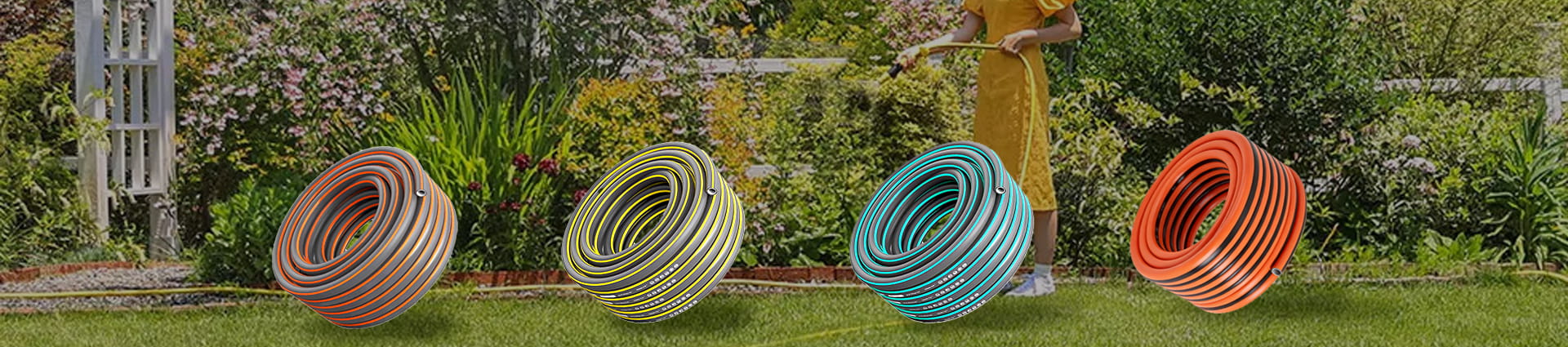
Most complete Garden Hoses should not be placed in ordinary curbside recycling bins. Flexible hoses may contain PVC or another polymer, polyester reinforcement, metal fittings, washers, coatings, and printed layers that are difficult for standard recycling facilities to separate.
Long hoses can also wrap around sorting equipment. Local disposal rules should be checked before recycling or discarding one.
A garden hose may look like one piece of plastic, but reinforced products are often multilayer structures.
A typical PVC garden hose may include:
Smooth PVC inner layer
Polyester fiber reinforcement
Colored PVC outer cover
Printed branding
Plastic or brass couplings
Rubber or elastomer washers
Metal clamps or crimp sleeves
These materials improve pressure resistance, flexibility, appearance, and connection performance. They also make the complete product harder to process as one recycling stream.
A recycling symbol on one component does not necessarily mean the full assembled hose belongs in a household recycling cart.
Garden hoses, electrical cords, ropes, chains, and similar long products can wrap around shafts, screens, and conveyor equipment at material-recovery facilities.
This creates:
Sorting interruptions
Manual removal work
Equipment damage
Worker-safety risks
Contamination of otherwise recyclable material
For this reason, many local recycling programmes specifically exclude garden hoses from curbside collection.
Cutting a hose into shorter pieces does not automatically make it acceptable. The material composition remains the same, and the recycler may still reject it.
Recycling availability depends on the city, country, material, and collection network.
Possible routes include:
Manufacturer take-back programmes
Specialist garden-product recycling
Flexible PVC recyclers
Commercial plastic recovery companies
Scrap-metal collection for separated brass fittings
Local household-waste facilities
Municipal special-drop-off events
Contact the facility before delivery and describe the hose accurately.
Useful information includes:
PVC, TPE, rubber, or unknown material
Reinforced or unreinforced construction
Total quantity
Presence of brass or plastic fittings
Contamination from chemicals
Commercial or household source
A commercial recycler may accept a clean, sorted production batch while rejecting individual used household hoses.
Brass and other metal couplings may have a separate recycling value when removed and accepted by a local metal recycler.
Plastic fittings depend on their resin type, size, cleanliness, and local programme.
Do not dismantle a pressurized or contaminated industrial hose without suitable controls.
For an ordinary garden hose, remove reusable connectors only when this can be done safely. Clean fittings may also be kept as repair parts rather than immediately recycled.
Washers and small mixed-material components normally need to follow local waste guidance.
A hose that no longer holds full water pressure may still have non-pressure uses.
Possible reuse ideas include:
Protective covering around tool handles
Padding around chains
Garden edging
Support for young trees
Short sleeves around sharp surfaces
Drip-watering sections after controlled perforation
Storage ties
Workshop protection sleeves
Do not reuse a deteriorated hose for drinking water, food contact, hot fluids, fuel, gas, compressed air, or another safety-critical application.
A hose with chemical contamination should not be repurposed around plants, animals, or children.
Keeping a hose in service longer reduces replacement frequency and waste.
Useful maintenance practices include:
Release water pressure after use.
Drain the hose before storage.
Keep it away from sharp edges.
Avoid vehicle traffic.
Store it on a reel or hanger.
Protect it from prolonged direct sunlight.
Prevent freezing with water inside.
Replace damaged washers promptly.
Repair only suitable localized damage.
Avoid exceeding the rated pressure.
A severe bulge, exposed reinforcement, deep crack, or loose coupling is a sign that the hose may no longer be safe for pressurized use.
Environmental improvement is not limited to claiming that a product is recyclable.
For wholesale and private-label buyers, practical decisions may include:
Selecting a suitable wall thickness rather than excessive material
Improving UV and aging resistance
Using replaceable connectors
Offering repair fittings
Reducing unnecessary packaging
Selecting recyclable carton structures
Printing accurate care instructions
Avoiding misleading disposal claims
Matching hose life to the real application
Longer product life and easier repair can reduce waste even where the complete reinforced hose has limited recycling access.
As a PVC garden hose OEM / ODM Manufacturer, our factory controls the main production stages from material formulation to finished packaging.
Our equipment includes extrusion, polyester braiding, winding, marking, cutting, connector assembly, and testing systems. Product development can be adjusted around:
Hose diameter
Length
Pressure rating
Material formulation
Reinforcement design
UV and aging requirements
Color and printing
Replaceable fittings
Repair Accessories
Packaging reduction
Carton and label design
Pressure, burst, aging, and material testing can be planned according to the approved specification.
Provide the application, expected outdoor exposure, hose size, required pressure, connector design, target service life, order quantity, and packaging goals.
Our team can review material, reinforcement, repairability, accessory selection, and packaging together. A proposal can include sample development, performance testing, brand printing, care information, bulk manufacturing, and export delivery.