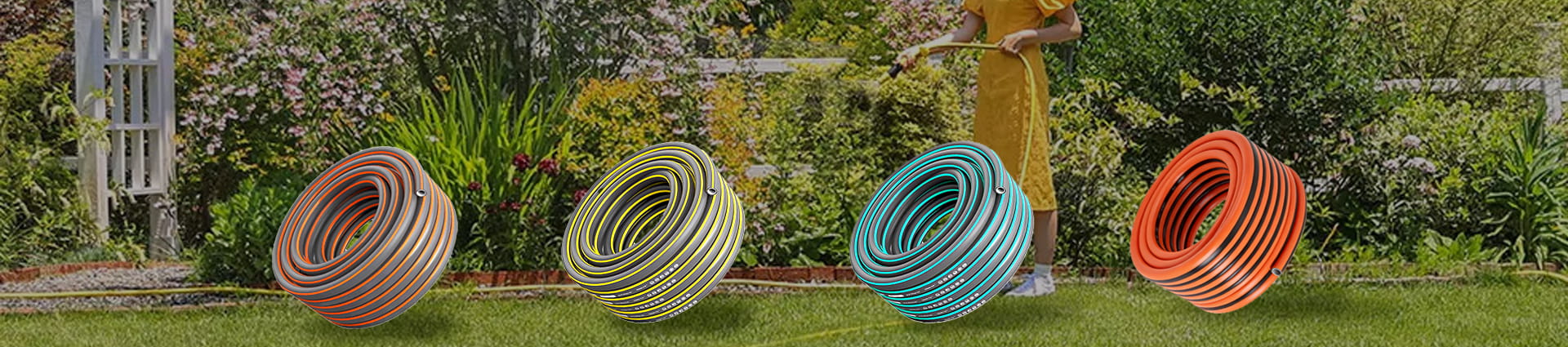
Garden Hoses and Gas Hoses may both be flexible PVC hoses, but they cannot be used interchangeably because they are designed for different media, pressure conditions, permeability limits, temperatures, fittings, and safety requirements. A garden hose carries water for irrigation or cleaning, while a gas hose must control the transfer of LPG, propane, or another specified gas without unacceptable leakage.
Similar color, diameter, or reinforcement does not make two hoses functionally equivalent.
The inner tube remains in direct contact with the transferred medium. In a garden hose, the formulation is selected mainly for water delivery, flexibility, handling, and outdoor use.
A gas hose needs an inner layer formulated for the specified gas. Gas molecules may permeate through materials that perform normally with water. The manufacturer must therefore consider gas compatibility, permeability, pressure, temperature, and long-term exposure.
Using a water hose for gas service can create leakage even when no visible crack appears on the hose surface.
Both hose types may contain polyester braiding, but the reinforcement is not automatically identical.
A garden hose commonly needs enough reinforcement to:
Resist household water pressure
Reduce expansion
Limit kinking
Support repeated dragging
Maintain flexibility
Withstand outdoor handling
A gas hose requires reinforcement suited to its rated gas pressure and connection system. The braid angle, yarn density, material strength, wall thickness, and adhesion between layers influence pressure performance.
The working pressure and burst pressure printed for a garden hose cannot be transferred to gas service.
Garden hoses are exposed to sunlight, soil, abrasion, rain, and repeated bending. Their outer covers are generally designed around weather resistance, appearance, and handling.
Gas hoses may encounter heat, grease, flame exposure, appliance surfaces, outdoor cooking environments, or industrial conditions. The cover must match the intended installation rather than merely appear durable.
Our PVC garden hoses are available in reinforced structures for irrigation, cleaning, gardening, and car washing. Gas applications require products specifically developed and marked for gas transfer.
A garden connector may be designed for a tap, nozzle, or irrigation accessory. Gas systems use fittings selected for the cylinder, regulator, appliance, pressure, thread, sealing method, and destination-market requirements.
An unsuitable fitting can leak even when the hose body remains intact. Buyers should verify:
Hose bore
Fitting material
Thread or connection standard
Crimping dimensions
Sealing method
Pull-off resistance
Compatibility with the gas system
Clamps and fittings should never be improvised from garden-hose Accessories.
Orange, black, blue, red, or another color may help distinguish a hose, but color alone does not prove gas compatibility or compliance.
Check the hose marking for the intended gas, size, pressure, applicable standard, manufacturer identification, and production information required by the market. An unmarked hose should not be accepted for a safety-sensitive gas installation merely because it resembles an approved product.
As a garden hose and gas hose OEM/ODM manufacturer, we develop hose structures according to the transferred medium and application. Customization can include diameter, wall thickness, material formulation, reinforcement, working pressure, color, printing, fittings, length, and packaging.
Our in-house system covers extrusion, braiding, winding, finished-hose inspection, pressure testing, burst testing, aging evaluation, and material checks. This allows water and gas hose projects to follow separate technical requirements instead of sharing one general PVC tube.
Use a garden hose only for the water-related application stated by its manufacturer. Use a gas hose specifically designed, marked, tested, and approved for the gas system involved.
The cost of selecting the correct hose is small compared with the consequences of leakage, fire, equipment damage, or product recall.
Previous: What Is a PVC Hose and What Is It Used For?
Next: What Is An LPG Hose?