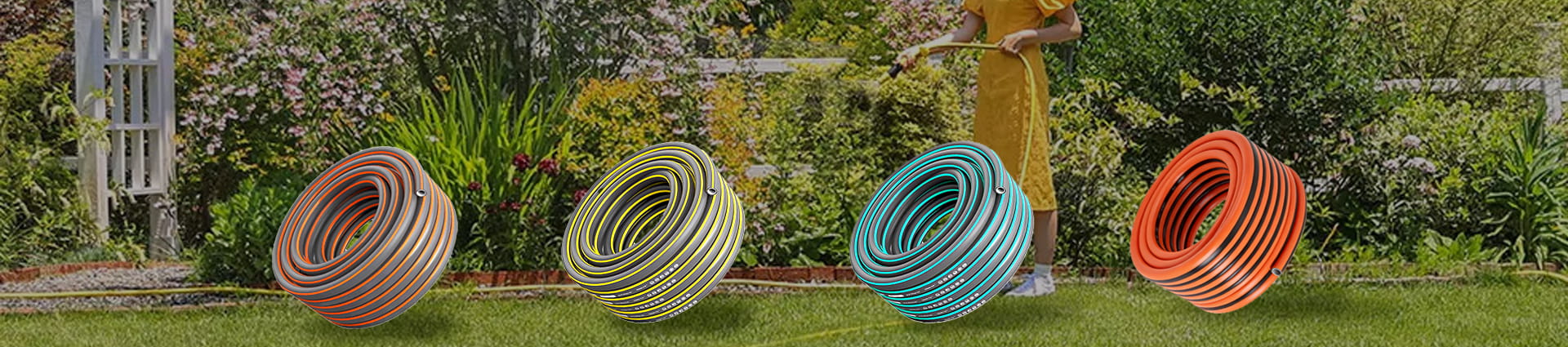
Garden Hoses and high-pressure hoses differ mainly in wall design, reinforcement strength, pressure margin, fitting retention, and resistance to operating stress. A garden hose is developed for manageable water delivery and frequent handling, while a high-pressure hose must control greater internal force without excessive expansion, leakage, or structural failure.
Making a hose wall thicker does not automatically turn a garden hose into a high-pressure hose.
| Structural element | Garden hose | High-pressure hose |
|---|---|---|
| Inner tube | Designed for compatible water service | Matched to the pressurized medium |
| Reinforcement | Supports household or light-commercial pressure | Higher-strength or denser reinforcement |
| Outer cover | Weather, dragging, flexibility and appearance | Abrasion, pressure stress and demanding use |
| Wall design | Balanced for handling and cost | Engineered around pressure and safety margin |
| Fittings | Tap, nozzle or hose-reel connections | Rated fittings with controlled retention |
| Testing focus | Flow, kinking, pressure and outdoor durability | Working pressure, burst, leakage and assembly integrity |
Actual specifications depend on the model and should be confirmed from technical data.
Pressure pushes outward against the hose wall. As internal pressure rises, the tube tries to expand in diameter and shorten or change shape.
Reinforcement limits this movement. Important variables include:
Yarn material
Yarn tensile strength
Number of yarns
Braiding angle
Braid density
Coverage
Bonding between layers
Uniformity along the hose
A visually similar braid can produce different pressure results when any of these variables changes.
A high-pressure spray hose may carry water mixed with an agricultural or cleaning solution. The inner tube must resist the actual medium at the expected concentration and temperature.
A conventional garden hose is generally developed for water-related tasks. It should not be assumed suitable for chemical spraying, compressed air, gas, fuel, or high-pressure cleaning.
Compatibility should be confirmed before determining the reinforcement structure.
The hose body may pass a pressure test while the finished assembly leaks or separates at the fitting.
High-pressure projects require control of:
Hose inner and outer diameter
Fitting insert dimensions
Crimp diameter
Sleeve design
Fitting material
Pull-off resistance
Seal condition
Assembly consistency
A connector intended for an ordinary garden hose may not retain a high-pressure hose safely.
A high-pressure hose still needs to bend, route, coil, and move during use. Excessive stiffness makes handling difficult and can concentrate stress near the fittings. Excessive softness may allow expansion, kinking, or reduced pressure stability.
The material formulation, wall thickness, reinforcement, and temperature range must therefore be developed together.
Our factory operates extrusion, braiding, and winding systems that control production from raw material to finished packaging. For high-pressure programs, structure development can cover inner-tube formulation, reinforcement pattern, wall thickness, outer-cover properties, fitting matching, and printing.
As a reliable export supplier of high-pressure PVC hoses, we conduct pressure, burst, aging, and material tests in our in-house laboratory. Buyers can specify diameter, length, working pressure, burst requirement, operating temperature, medium, fittings, color, marking, and packaging.
Our high-pressure hose range is intended for applications such as spraying, cleaning, and pressurized fluid transfer. Final suitability must be confirmed for the selected product and complete assembly.
Garden-hose design prioritizes easy handling, outdoor durability, water delivery, and competitive cost. High-pressure hose design begins with the force created by the specified pressure and medium.
Use the approved hose structure for its stated duty. Similar appearance is not evidence of equal pressure capacity.