Selecting the right PVC hose begins with the medium. Water, compressed air, gas, and spray solutions interact differently with the inner tube, reinforcement, fittings, and operating environment. The hose should be specified as a complete assembly rather than selected from color, diameter, or price alone.
The following sequence helps prevent a hose intended for one service from being placed in another.
“Liquid” or “gas” is not enough information.
State whether the hose will carry:
Clean water
Irrigation water
Compressed air
LPG
Propane
Agricultural spray solution
Detergent mixture
Another identified medium
Provide the concentration and available technical information for chemical mixtures. Compatibility may change when temperature or concentration changes.
Give the normal working pressure, maximum expected pressure, surge conditions, and frequency of pressurization.
A hose used continuously at stable pressure experiences a different duty cycle from one repeatedly started and stopped. Do not select a hose by burst pressure alone; burst testing measures a short laboratory event, not the recommended continuous operating condition.
Record both medium temperature and ambient temperature. A hose exposed to direct sunlight may become hotter than the surrounding air.
Low temperatures can reduce flexibility, while high temperatures can soften PVC and affect pressure performance. Ask for the permitted pressure at the intended temperature rather than assuming the room-temperature rating remains unchanged.
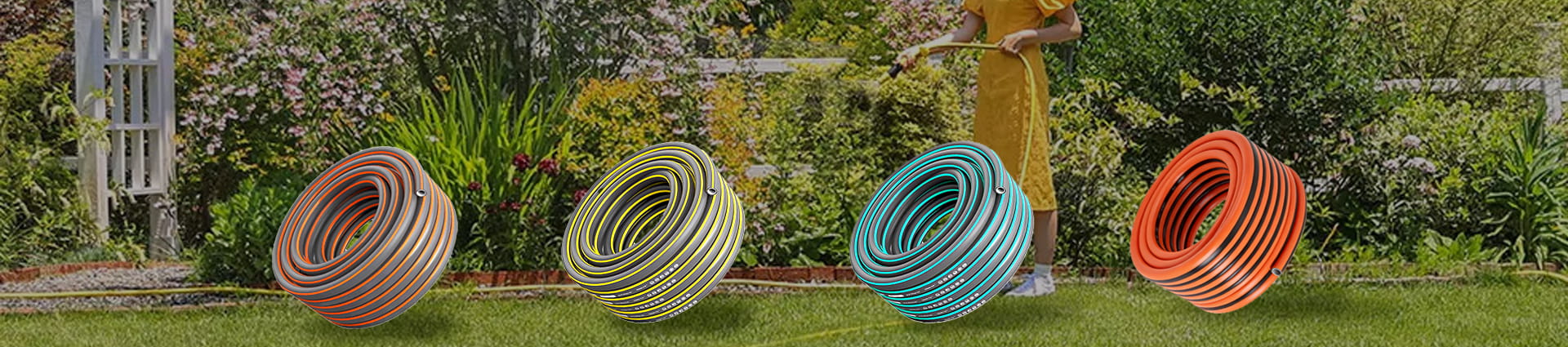
A reinforced Garden Hose can support irrigation, landscaping, car washing, and outdoor cleaning. Flexibility, weather resistance, anti-kink performance, and connector compatibility are common priorities.
Compressed-air hose selection should consider pressure, oil mist, tool movement, abrasion, and fitting retention. A water hose should not automatically be used for pneumatic tools.
Use only a hose designed, marked, and approved for the specified gas service. Gas permeability, flame and heat exposure, fittings, and destination standards require separate review.
A spray hose must match the pressure and chemical solution. Agricultural spraying may require stronger reinforcement and greater chemical resistance than household watering.
Inner diameter affects flow and pressure loss. A hose that is too narrow can restrict the system, while an unnecessarily large hose adds weight and material cost.
Longer hoses generally create more pressure loss and are harder to handle. Confirm the installed route before specifying roll length.
Provide drawings or samples of the mating connection. Confirm thread, insert, sleeve, sealing method, connector material, and crimping requirement.
The fitting must be rated for the same medium, pressure, and temperature as the hose body.
Request test conditions for:
Dimensional inspection
Working-pressure test
Burst-pressure test
Leakage test
Aging test
Fitting retention
Material compatibility where required
The hose marking and packaging should clearly identify the application and model to reduce misuse after distribution.
As a custom PVC hose OEM/ODM manufacturer, we adjust diameter, material formulation, wall thickness, reinforcement, pressure rating, color, printing, fitting configuration, length, and packaging around the project requirement.
Our OEM/ODM process moves from technical confirmation and sample development to in-house production and final inspection. Supplying an existing hose sample together with application data can shorten the comparison process.
Choose the hose that matches all five limits: medium, pressure, temperature, environment, and fittings. When one of these is unknown, pause the specification rather than filling the gap with an assumption.