PVC pipe size should be measured by identifying its outside diameter, inside diameter, and nominal size. For connection projects, the fitting type and thread standard must also be confirmed before selecting an adapter.
PVC pipe is commonly described using a nominal size rather than simply stating the measured outside diameter.
This means a pipe marked with a particular inch size may not measure exactly that number across its outside surface.
For hose and adapter selection, relying only on the printed nominal size can therefore cause problems.
The measurement should distinguish between:
Outside diameter
Inside diameter
Wall thickness
Nominal pipe size
Connection type
OD means outside diameter.
ID means inside diameter.
For a rigid PVC pipe, the outside diameter is measured across the outside edges of the pipe. The inside diameter is measured across the internal opening.
Wall thickness is the difference between the two.
| Measurement | Meaning | Why It Matters |
|---|---|---|
| OD | Outside diameter | Fitting compatibility |
| ID | Inside diameter | Flow passage |
| Wall thickness | Material between OD and ID | Pressure and structure |
| Nominal size | Standard designation | Product identification |
| Thread size | Connection specification | Adapter compatibility |
For a Garden Hose connection, the pipe's nominal size alone is not enough.
A caliper is the most convenient tool for accurate measurement.
Place the caliper across the widest part of the pipe without compressing the material.
Record the measurement in millimeters or inches.
For larger pipe, a tape measure can provide an approximate circumference, which can then be converted to diameter:
Diameter ≈ Circumference ÷ 3.1416
A caliper is still preferable when selecting a close-fitting component.
Measure across the open end of the pipe from one inner wall to the opposite inner wall.
The measurement should be taken perpendicular to the pipe centerline.
Inside diameter matters when the objective is to understand water flow or match an internal insert.
However, when purchasing a threaded adapter, the connection type and nominal pipe standard can be more important than ID alone.
Wall thickness can be determined from the outside and inside measurements:
Wall Thickness = (OD − ID) ÷ 2
For example, if a pipe has an outside diameter of 25 mm and an inside diameter of 19 mm:
(25 − 19) ÷ 2 = 3 mm wall thickness
This is useful when comparing pipe constructions or checking whether an existing pipe matches a specification.
Different projects require different levels of accuracy.
| Tool | Best Use |
|---|---|
| Caliper | OD and ID measurement |
| Tape measure | Large pipe circumference |
| Thread gauge | Thread pitch |
| Ruler | Quick approximate measurement |
| Manufacturer drawing | Final production confirmation |
For OEM or bulk purchasing, a drawing or physical sample is preferable to a handwritten measurement alone.
This is where many connection problems occur.
A PVC pipe and a garden hose may use different connection systems.
A typical arrangement can be:
PVC Pipe → PVC Adapter → Threaded Hose Adapter → Garden Hose
Before selecting the parts, confirm:
PVC pipe OD or nominal size
Existing pipe-end connection
Hose diameter
Garden hose thread
Adapter gender
Working pressure
A garden hose diameter does not automatically tell you which pipe adapter is required.
Usually, an adapter is required.
The pipe may use a solvent-weld socket, compression fitting, male pipe thread or female pipe thread, while the hose normally uses a garden hose coupling or quick connector.
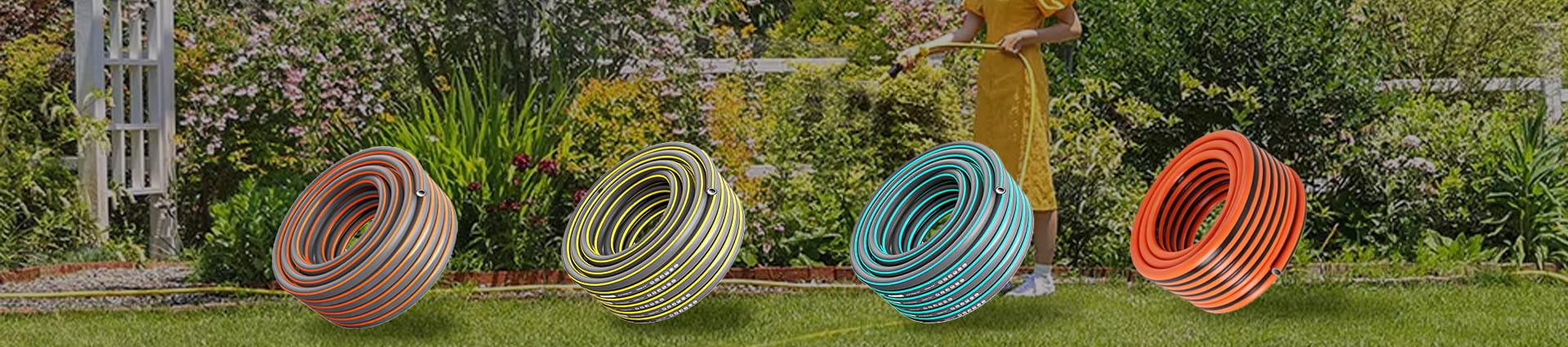
Our Durable Reinforced PVC Lightweight Garden Hose Pipe is available in 1/2, 5/8 and 3/4-inch hose diameters and can be supplied with brass connectors and tap adapters.
The adapter should be selected according to both sides of the connection.
A mismatch can cause:
Leakage
Restricted water flow
Loose connections
Damaged threads
Excessive stress on plastic fittings
Hose separation
Forcing an adapter into an apparently similar connection is not a reliable solution.
The thread type and sealing method should be confirmed first.
Pipe size affects potential flow capacity, but it is not the only factor.
Flow can also be influenced by:
Hose length
Pressure
Fitting bore
Number of connectors
Valves
Nozzle design
Kinks
Elevation changes
A larger pipe does not automatically guarantee better performance if the downstream hose or fitting is restrictive.
When requesting a hose-and-adapter quotation, useful information includes:
Pipe photograph
Pipe OD
Pipe ID
Nominal size if known
Existing fitting
Hose diameter
Required hose length
Working pressure
Target market
Required quantity
A photo of the actual connection point can also help identify the existing configuration.
For projects involving PVC pipe and garden hose connections, our previous guide on How To Connect Garden Hose To PVC Pipe can also be used as a reference.
If the pipe size is uncertain, send the measured OD/ID, a photo of the pipe end, the hose diameter and the intended connection.
Our team can help match the hose, adapter, connector and pressure requirements before production.
For samples, customized fittings or bulk supply, submit the complete requirements through the Request A Quote page.