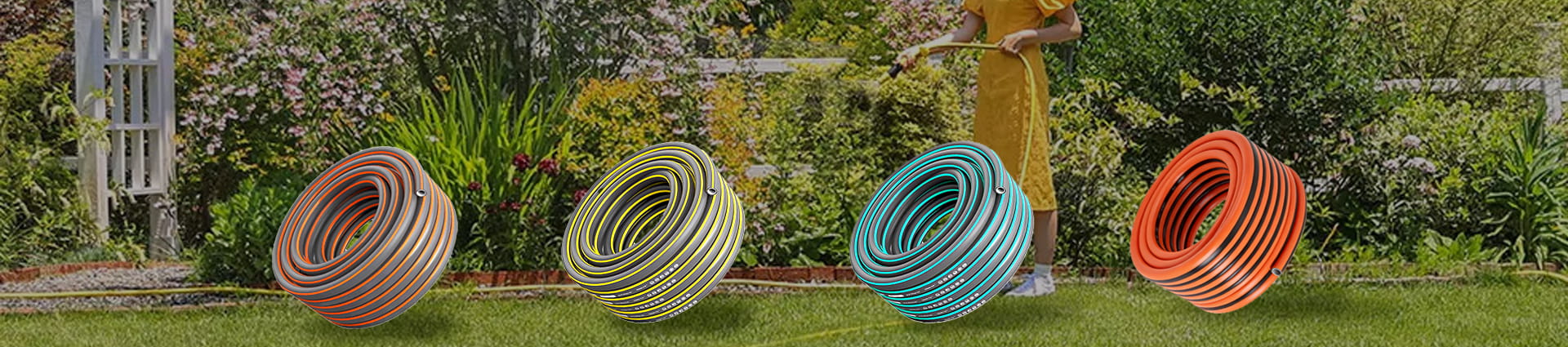
Most Garden Hoses sold in the North American market use a 3/4-inch Garden Hose Thread, commonly written as 3/4 GHT, 3/4 GH, or 3/4 NH. This connector size is separate from the hose’s internal diameter, which may be 1/2, 5/8, or 3/4 inch.
The thread standard must be confirmed by market because garden hose connectors used in North America, the United Kingdom, Europe, Australia, and other regions are not always interchangeable.
Garden Hose Thread describes the screw connection used between a hose, outdoor faucet, nozzle, sprinkler, hose reel, or adapter.
In a common garden watering system, the outdoor faucet has a male thread. The hose inlet has a female coupling that screws onto the faucet. The opposite end of the hose normally has a male connection for attaching a spray nozzle or sprinkler.
The thread provides mechanical engagement, but the watertight seal is normally created by a flat washer inside the female connector. Tightening the connection compresses the washer against the flat face of the male fitting.
This is why adding thread-sealing tape does not normally solve a leaking garden hose coupling. A missing, hardened, damaged, or incorrectly sized washer is often the real cause.
| Item | Common North American Specification | What It Describes |
|---|---|---|
| Connector thread | 3/4-inch GHT or NH | Thread used on the hose coupling |
| Thread pitch | Commonly 11.5 threads per inch | Distance and frequency of the threads |
| Hose inner diameter | 1/2, 5/8, or 3/4 inch | Internal water passage |
| Hose length | 10–100 m or market-specific lengths | Total usable hose length |
| Seal | Flat rubber or elastomer washer | Creates the watertight connection |
A hose labeled 5/8 inch usually refers to the water passage inside the hose rather than the connector thread. It may still use a 3/4-inch hose coupling.
This distinction matters when sourcing replacement connectors, hose repair fittings, faucet adapters, and complete retail kits.
Garden Hose Thread and National Pipe Thread are different connection systems.
GHT is normally a straight thread that seals against a washer. NPT is a tapered pipe thread that becomes tighter as the male and female threads engage.
They may appear close in size, but they should not be forced together. An incorrect connection can:
Damage the thread
Crack a plastic fitting
Create an unstable joint
Produce continuous leakage
Make later removal difficult
Cause product returns
A purpose-made GHT-to-NPT adapter should be used when a garden hose needs to connect to pipework using a different thread standard.
A garden hose kit that fits an outdoor faucet in the United States may not connect directly to a tap in the United Kingdom or another market.
Differences may involve:
Thread form
Nominal size
Outside diameter
Pitch
Male and female arrangement
Washer seat
Tap-adapter structure
Quick-connect system
Retail buyers should identify the destination market before confirming connectors and packaging.
Clear labels should show both the hose diameter and fitting standard. A package that displays only “1/2 inch hose” may confuse customers who expect that number to describe the faucet thread.
Begin by examining the connector for a stamped or molded size.
When no marking is available, measure:
The outside diameter of the male thread
The inside diameter of the female coupling
The number of threads within a measured distance
The hose’s internal diameter
The washer-seat shape
The connector material
Use a caliper for more reliable measurements. A tape measure is less accurate for distinguishing similar fittings.
Also inspect the thread profile. A straight hose thread remains approximately the same diameter along its length, while a tapered pipe thread changes gradually.
Do not test compatibility by forcing two unknown connectors together.
A leaking connection is not always caused by the thread itself.
Common causes include:
Missing washer
Flattened or cracked washer
Cross-threading
Dirt on the sealing face
Deformed plastic coupling
Damaged brass thread
Incorrect regional standard
Excessive tightening
Side load from a heavy hose
Connector installed at an angle
Hand tightening is normally sufficient for a standard garden hose coupling. Excessive tool force can deform the washer or crack the connector.
The hose should also be supported so its weight does not continuously pull sideways on the faucet.
Our production system includes PVC material preparation, extrusion, polyester reinforcement, braiding, marking, cutting, connector assembly, testing, and packaging.
This allows hose and fitting compatibility to be checked as one complete product rather than sourcing the tube and connectors separately.
As a 3/4 inch garden hose thread connector OEM manufacturer, we can coordinate:
1/2, 5/8, and 3/4-inch hose diameters
Target-market thread standards
Plastic or brass connectors
Faucet adapters
Quick-connect fittings
Nozzles and spray guns
Washer materials
Hose length and color
Brand printing
Header cards and cartons
Our in-house laboratory can evaluate material, pressure, burst performance, aging behavior, and finished connection stability according to the approved product specification.
Provide the destination country, hose diameter, connector thread, faucet type, working pressure, required Accessories, order quantity, and packaging format.
Our team can prepare a matching hose-and-connector specification, sample, pressure-testing plan, private-label design, and bulk-production quotation. Confirming the thread system before production helps reduce leakage complaints and market returns.
Previous: What Thread Is on A Garden Hose?