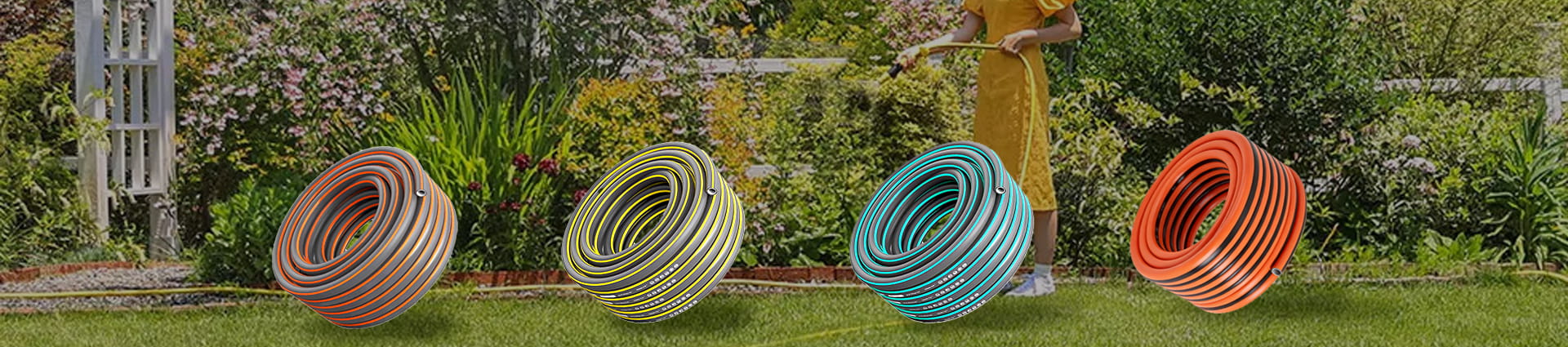
A good Garden Hose delivers water consistently, bends without collapsing, resists ordinary outdoor wear, and remains easy to handle over its intended working life. The quality of a PVC garden hose depends on its material formulation, reinforcement structure, wall thickness, fittings, pressure suitability, and compatibility with the local climate.
Color and appearance may influence retail presentation, but they do not reveal whether the hose is suitable for frequent watering, outdoor cleaning, irrigation, or commercial landscaping.
PVC garden hoses are produced from a formulated material rather than pure PVC resin alone. Plasticizers, stabilizers, pigments, and other processing materials influence flexibility, surface condition, temperature behavior, and aging performance.
A hose that feels extremely soft in a showroom is not automatically better. Excessive softness may reduce kink resistance or dimensional stability. A formulation that is too rigid can make the hose difficult to coil, particularly in cooler conditions.
The correct formulation should balance flexibility, strength, processing stability, and the requirements of the destination market.
Many garden hoses use a layered construction consisting of an inner tube, textile reinforcement, and an outer cover. Each layer serves a different purpose:
The inner tube carries water.
The reinforcement helps the hose retain its shape under pressure.
The outer cover protects against abrasion, dirt, sunlight, and handling.
Braiding density, yarn quality, braid angle, and adhesion between layers affect pressure resistance. Decorative reinforcement that looks dense but is poorly integrated with the hose body may not provide reliable performance.
Kinking interrupts water flow and can create stress at the folded point. Hose diameter, wall thickness, reinforcement, flexibility, and coil memory all influence how easily a garden hose kinks.
No flexible hose is completely immune to poor handling. Pulling a tightly twisted hose around corners or leaving it folded under heavy objects can still restrict water flow. A good hose should recover from normal bending without permanent flattening.
Common household garden hose inner diameters include 1/2 inch, 5/8 inch, and 3/4 inch. A wider internal diameter can deliver more water, but the final flow also depends on source pressure, hose length, fittings, nozzle restriction, and elevation.
Longer is not always better. An unnecessarily long hose is heavier, takes more time to drain, occupies more storage space, and may reduce pressure at the outlet.
Buyers should select the shortest length that comfortably reaches the working area.
A high-quality hose can still leak if its couplings, ferrules, clamps, or washers are poorly matched. Connector thread must suit the destination market, while the hose tail must fit the actual tube diameter.
North American household garden hoses commonly use 3/4-inch GHT connections. Other markets may use BSP-based fittings or quick-connect systems. Thread designation, sealing method, connector material, and corrosion resistance should be confirmed before production.
Useful quality checks include:
Dimensional inspection
Working-pressure testing
Burst-pressure testing
Leakage testing at fittings
Bending and kink assessment
Adhesion checks between layers
Aging and material evaluation
Coil length verification
Printing and packaging inspection
Our in-house laboratory conducts pressure, burst, aging, and material tests as part of batch quality control. The specification and acceptance criteria should be agreed upon before mass production.
A dependable PVC garden hose wholesale supplier should control extrusion, braiding, winding, testing, and packaging instead of relying only on final visual inspection. Buyers should also confirm whether diameter, length, reinforcement, color, printing, fittings, and packaging can remain consistent across repeat orders.
Our garden hose range is supported by in-house extrusion, braiding, and winding capabilities. We can develop garden hoses around different market requirements and private-label programs while maintaining control from material preparation to finished packaging.
A good garden hose is ultimately one that matches its real task. Supplying the required diameter, working pressure, length, climate, fittings, packaging, and order quantity allows us to recommend a more appropriate construction.