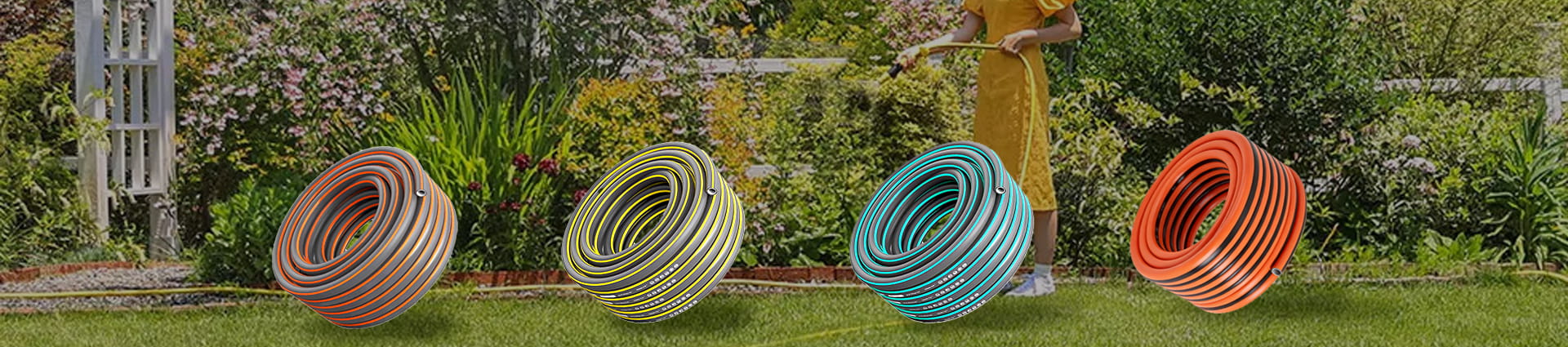
Selecting a Garden Hose for home tasks starts with five questions: how far must the hose reach, how much water is needed, how often will it be used, where will it be stored, and which fittings are compatible with the faucet and Accessories.
A practical household hose should reach the working area without excessive spare length, remain manageable when filled with water, and support the pressure of the home water supply.
List the jobs the hose must perform. Common household applications include:
Watering plants and lawns
Connecting a sprinkler
Washing a car or bicycle
Rinsing patios and balconies
Cleaning gardening tools
Filling a small pool or container
Supplying water to a soaker hose
General outdoor maintenance
A compact patio hose and a hose used across a large garden require different lengths and handling characteristics.
Measure from the outdoor faucet to the farthest working point and allow enough additional length for practical movement. Avoid buying a much longer hose “just in case.”
Extra length adds weight, increases storage requirements, and can reduce outlet performance. It also creates more hose to drag around corners and obstacles.
For larger properties, two hoses connected only when needed may be easier to store than one permanently oversized coil.
Three commonly encountered garden hose inner diameters are:
1/2 inch: light watering and compact spaces
5/8 inch: general household gardening and cleaning
3/4 inch: higher-volume delivery and longer runs
These are general use directions rather than fixed performance guarantees. Actual flow depends on the faucet, pressure, hose length, fittings, elevation, and nozzle.
A reinforced PVC garden hose is a practical choice for many homes because it combines flexibility with pressure support. The reinforcement should be integrated evenly between the inner tube and outer cover.
Inspect the hose for inconsistent diameter, surface defects, exposed reinforcement, weak fittings, or sharp bends caused by poor packaging.
For frequent use, a more robust construction may offer better handling durability. For occasional balcony watering, a lighter hose may be more convenient.
Confirm the outdoor faucet thread and the accessories to be connected. North American garden hoses commonly use 3/4-inch GHT, while BSP-based fittings and quick connectors are common in other markets.
A female coupling normally seals against a washer. Replacing a worn washer is often enough to stop a leak at the faucet connection.
Connector material also affects weight, corrosion behavior, and impact resistance. Brass, aluminum, and engineered plastic fittings can all be suitable when correctly designed for the application.
Hot sunlight can increase surface temperature and accelerate material aging. Freezing conditions can damage a hose if water remains trapped inside.
After use:
Turn off the water source.
Release remaining pressure.
Drain the hose.
Coil it without tight bends.
Store it away from sharp tools and vehicle traffic.
Protect it from prolonged sunlight when possible.
Do not leave the hose continuously pressurized when it is not being used.
A commercial-grade PVC garden hose may be appropriate for large properties, cleaning contractors, workshops, property maintenance teams, or households that use the hose frequently.
A commercial-grade designation should be supported by measurable construction and performance information. Wall thickness, reinforcement, working pressure, burst pressure, fittings, temperature range, and test method are more useful than a marketing label alone.
Our factory manufactures PVC garden hoses through integrated extrusion, braiding, winding, and packaging processes. Available customization can cover size, length, color, reinforcement, printing, fittings, and retail packaging.
Choose a lightweight hose for short, occasional watering; a reinforced 5/8-inch-style general-purpose hose for common home tasks; or a stronger, larger-bore model for frequent use and higher water-volume requirements.
Before purchasing, check the faucet connection, required reach, storage method, expected pressure, and local climate. These five details prevent most common garden hose selection mistakes.