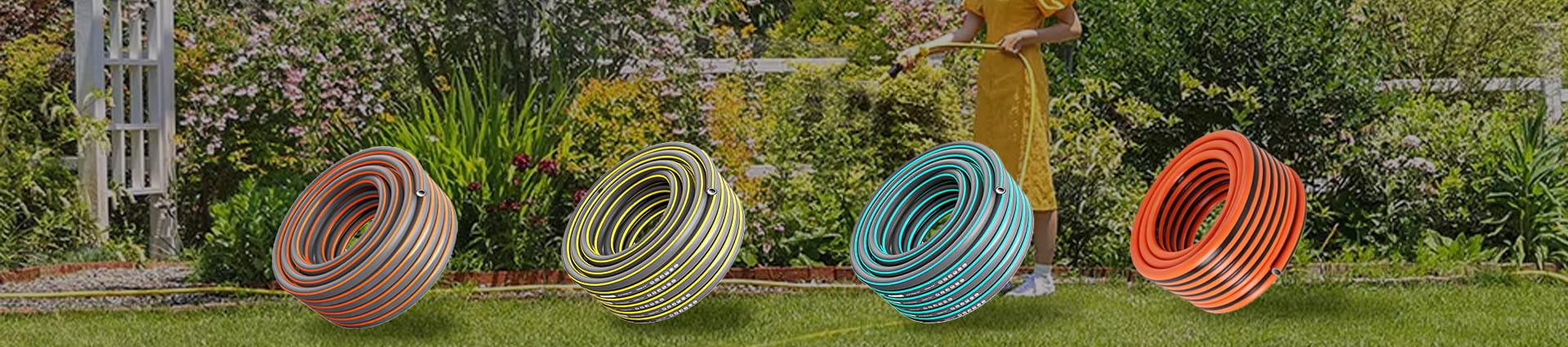
Choosing the right fittings for a Garden Hose requires matching the hose diameter, tap connection, nozzle, reel, water pressure, and application. The most common mistakes are selecting the wrong size, ignoring the sealing washer, and combining fittings that use different connection systems.
For retailers, irrigation distributors, landscaping companies, and garden equipment importers, the correct fitting set improves usability and reduces leakage complaints. JITONE supplies hose connectors, faucet adapters, nozzles, reels, and PVC or TPE hoses for complete product development.
Garden hoses are commonly identified by their inside diameter or nominal size. Common options include:
1/2 inch
5/8 inch
3/4 inch
The fitting must match the hose structure and outer diameter. A connector designed for a 1/2-inch hose may not grip a 5/8-inch hose securely, even if the difference looks small.
For a private-label hose kit, buyers should confirm:
Hose inside diameter
Hose outside diameter
Wall thickness
Reinforcement layer
Connector grip range
Clamp or locking structure
JITONE provides hoses and matching Accessories in several common sizes, allowing buyers to develop complete kits instead of sourcing every component separately.
The faucet or water outlet determines the type of adapter required. Some garden taps use threaded outlets, while others require a clamp-style or universal adapter.
A faucet adapter may be needed when:
The tap thread does not match the hose connector
The outlet is smooth rather than threaded
The hose must connect to a kitchen or utility faucet
The system needs a quick-release connection
The customer uses several hose accessories
Common reducer configurations include 3/4 inch to 1/2 inch. Certain faucet-to-hose adapters are designed for faucets approximately 14 to 20 millimeters in diameter.
The adapter should be tested on the actual faucet profile. A universal-looking shape does not guarantee compatibility with every outlet.
Different tasks call for different connector designs.
Quick-connect fittings allow users to change nozzles, extension hoses, or water outlets without removing the entire system. They are convenient for retail hose kits and regular garden maintenance.
These fittings attach directly to the hose end and connect it to a nozzle, tap adapter, or reel. The gripping structure must hold the hose without cutting into the outer wall.
Brass fittings are suitable for repeated handling, outdoor cleaning, landscaping, and commercial applications. They provide strong threads and a durable connection feel.
Plastic fittings are lightweight and economical. They are often selected for household watering, consumer hose kits, and products requiring multiple color options.
The nozzle determines how water is delivered. A basic nozzle may provide a single spray pattern, while a multi-function nozzle can offer several options such as shower, mist, cone, flat, center, jet, and soaker modes.
Consider the intended use:
Mist for delicate plants
Shower for flower beds
Jet for concentrated cleaning
Flat spray for wider coverage
Soaker mode for gentle irrigation
Cone spray for general watering
JITONE supplies plastic and brass nozzles, including multi-function models and rotary-head designs. A nozzle should be matched to the connector size and hose pressure to avoid poor spray performance.
A fitting must be suitable for the expected water pressure. Household watering systems usually require different performance from high-pressure cleaning systems.
Buyers should confirm:
Normal working pressure
Maximum pressure
Burst pressure
Hose reinforcement
Connector locking strength
Sealing washer material
For example, a reinforced PVC hose may be suitable for higher pressure than a basic lightweight hose. A fitting set should not be marketed for demanding use unless the hose, connector, and nozzle have been evaluated together.
Use brass when strength, repeated assembly, and commercial durability are the main priorities. Use plastic when low weight, price control, and color customization are more important.
Many product lines can include both options. This allows a distributor to offer a standard household version and a premium commercial version using similar hose sizes.
A Customized Material Handling approach is not limited to industrial machinery. For garden equipment, it can include coordinated hose lengths, fitting sizes, nozzle functions, reel structures, colors, labels, and packaging.
| Problem | Likely Cause | Practical Check |
|---|---|---|
| Water leaks at tap | Wrong adapter or damaged washer | Confirm thread and seal |
| Hose slips out | Incorrect grip range | Match hose outside diameter |
| Nozzle is difficult to install | Incompatible connector | Check quick-connect size |
| Low water flow | Small passage or blocked filter | Inspect inner diameter |
| Fitting cracks | Excessive force or unsuitable material | Review torque and application |
| Reel connection leaks | Poor alignment | Check inlet and gasket |
A complete garden hose kit may include:
PVC or TPE hose
Hose reel or hanger
Tap adapter
Quick connectors
Spray nozzle
Brass fitting option
Sealing washers
Retail packaging
When all components are developed together, the buyer can reduce compatibility problems and simplify product instructions.
JITONE operates in-house production for PVC and TPE hoses, reinforced structures, hose reels, nozzles, connectors, and packaging coordination. The company’s OEM and ODM process begins with technical requirements, then moves through product development, sampling, mass production, and inspection. This supports garden hose kit customization for wholesalers and brand owners.
Before placing an order, confirm:
Hose diameter and length
Faucet type and size
Connector material
Nozzle spray functions
Working and burst pressure
Reel or hanger design
Color requirements
Private-label printing
Packaging dimensions
Required quantity and delivery schedule
Choosing garden hose fittings starts with the hose diameter and continues with the faucet, connector, nozzle, pressure, material, and application. The fitting should be tested as part of a complete system rather than purchased as an isolated component.
With in-house hose production, accessory matching, inspection, and OEM/ODM support, JITONE helps distributors and brands develop reliable garden hose solutions for household, commercial, irrigation, cleaning, and landscaping markets.