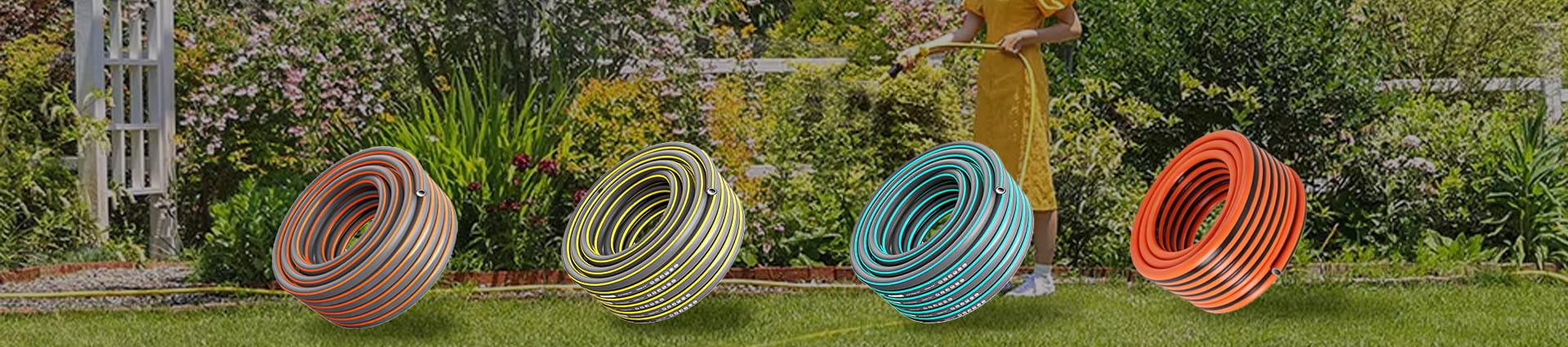
A Garden Hose is mainly designed for outdoor watering applications, while a water hose is a broader term covering hoses used for gardening, agriculture, industrial transfer, and other water-related applications. The correct choice depends on pressure requirements, materials, environment, and usage conditions.
The terms "water hose" and "garden hose" are often used interchangeably in daily communication, but for professional buyers, distributors, and product developers, they can represent different market categories.
A consumer may simply need a hose for watering plants.
However, a wholesaler, hardware distributor, or private label brand needs to understand:
Where the hose will be used
What pressure it must handle
Which material structure is suitable
What customers expect from the product
How long the hose should last
Choosing the wrong hose type can lead to problems such as:
Reduced service life
Customer complaints
Leakage issues
Poor market positioning
For hose manufacturers, the difference is not only about the name of the product. It involves material formulation, reinforcement structure, production process, and application requirements.
A garden hose is a flexible hose primarily designed for outdoor watering and gardening applications.
Typical uses include:
Residential gardens
Lawns
Landscaping
Plant irrigation
Outdoor cleaning
Garden hoses are usually designed around user convenience.
Important characteristics often include:
Flexibility
Lightweight handling
Resistance to outdoor conditions
Easy connection with nozzles and fittings
For retail markets, appearance, color options, packaging, and user-friendly design can also influence purchasing decisions.
However, professional buyers need to evaluate more than appearance.
The internal structure determines whether the hose can maintain performance after repeated bending, pressure changes, and outdoor exposure.
A water hose is a broader category that refers to hoses designed for transporting water.
Depending on the application, water hoses may include:
Garden hoses
Agricultural irrigation hoses
Industrial water hoses
Food-grade water hoses
Equipment connection hoses
Compared with general garden hoses, some water hose applications require higher performance standards.
For example:
An agricultural hose may need better pressure resistance.
An industrial water hose may require stronger reinforcement.
A commercial cleaning hose may need greater abrasion resistance.
Therefore, "water hose" describes a wider application range, while "garden hose" usually refers to a specific outdoor watering product category.
The biggest difference is usually the design requirement.
A garden hose is often optimized for flexibility and everyday use.
An industrial water hose is usually optimized for:
Higher pressure
More frequent operation
More demanding environments
Longer working hours
For example, a homeowner watering flowers may prioritize:
Lightweight design
Easy storage
Soft handling
A commercial user may prioritize:
Pressure stability
Wear resistance
Longer service life
This difference directly affects material selection and manufacturing structure.
Material is one of the most important factors when selecting a hose.
Common hose materials include:
PVC
Rubber
TPU
Other polymer compounds
Each material provides different performance characteristics.
PVC hoses are widely used because they provide a balance between:
Cost efficiency
Flexibility
Lightweight handling
Chemical resistance
For many garden hose applications, PVC provides practical performance at competitive pricing.
However, PVC formulation has a major influence on the final product.
A well-developed PVC compound can improve:
Low-temperature flexibility
UV resistance
Aging performance
Rubber hoses are often selected for applications requiring:
Higher durability
Better abrasion resistance
Stronger pressure performance
They are commonly used in more demanding environments where a longer service life is required.
However, rubber hoses are usually heavier and may have a higher production cost.
Many professional hoses use reinforcement layers.
The reinforcement can improve:
Pressure resistance
Dimensional stability
Resistance to expansion
For bulk buyers, the reinforcement structure is often more important than simply comparing the outer material.
A hose is not simply a tube made from plastic or rubber.
Its performance depends on how materials are processed.
During hose production, manufacturers need to control:
The formulation determines characteristics such as:
Flexibility
Strength
Aging resistance
Weather resistance
Incorrect material ratios may cause problems during long-term use.
The extrusion process affects:
Wall thickness consistency
Inner diameter accuracy
Surface quality
For large-volume orders, production consistency is critical.
A hose that performs well in a sample but varies between batches can create problems for distributors.
Professional hose manufacturers conduct performance checks to evaluate:
Working pressure
Burst resistance
Leakage performance
These tests help ensure the product meets expected application requirements.
For international buyers, product selection should consider the target market.
Important factors include:
Flexibility
Appearance
Packaging
User convenience
Buyers may focus more on:
Pressure performance
Durability
Frequent usage capability
Brand owners often require:
Custom colors
Packaging design
Size options
Product specifications
A manufacturer with OEM capability can help create products matching different market positions.
A reliable supplier should provide more than a product catalog.
Important evaluation factors include:
Manufacturing experience
Material control capability
Production capacity
Quality inspection system
Customization ability
For hose products, production consistency is especially important because distributors need stable quality across repeated orders.
A professional manufacturer should understand both product performance and market requirements.
A garden hose is one type of water hose designed mainly for outdoor watering, while water hose is a broader category covering different applications. The correct choice depends on pressure, material, working environment, and customer requirements.
For buyers developing a hose product line, selecting the right structure and material is more important than choosing based only on appearance or price.
For distributors, retailers, and private label brands, working with an experienced hose manufacturer helps create products with stable quality and suitable performance.