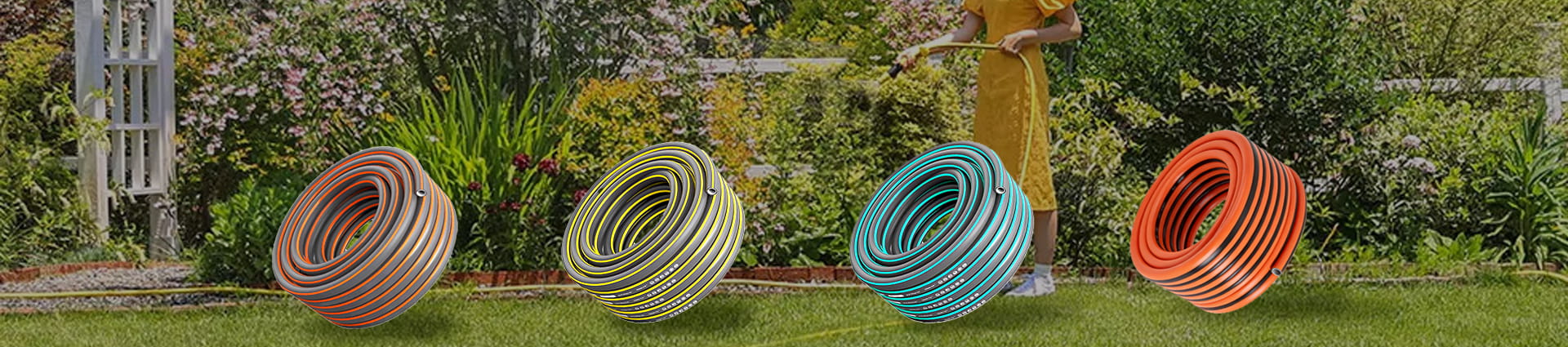
The thread on a standard North American Garden Hose is usually 3/4-inch GHT. The female end connects to an outdoor faucet, while the male end connects to a nozzle, sprinkler, reel, or another hose. Other markets may use BSP-based fittings or quick-connect adapters.
To choose the correct replacement fitting, buyers need to identify the connector thread, hose diameter, and sealing method separately.
A successful hose connection depends on more than one size.
The connector thread determines whether the coupling can screw onto the faucet, nozzle, or adapter.
For many North American products, this is 3/4-inch Garden Hose Thread.
The hose diameter describes the flexible tube rather than the threaded connector.
Common garden hose inner diameters include:
1/2 inch for lightweight watering
5/8 inch for general household use
3/4 inch for higher water volume or longer runs
The connector’s hose-tail or barb must fit the actual hose diameter.
A female garden hose coupling normally contains a flat washer. The washer presses against the end face of the male fitting and creates the seal.
An adapter designed to seal through tapered pipe threads works differently. Mixing the two sealing methods increases leakage risk.
A conventional garden hose usually has one female and one male connector.
The female coupling is commonly installed at the water-source end. It rotates around the hose so the user can attach it to an outdoor faucet without twisting the complete hose.
The male connector is commonly fitted at the delivery end. It accepts:
Spray nozzles
Watering wands
Sprinklers
Pressure-control valves
Hose extensions
Reel connections
Cleaning Accessories
When two hoses are joined, the male end of one hose connects to the female end of the next.
If both products have the same connector gender, a double-male or double-female adapter may be needed.
The two numbers describe different parts.
A 5/8-inch measurement often refers to the internal bore through which water flows. The 3/4-inch designation refers to the nominal hose-coupling thread.
This arrangement allows hoses with different flow capacities to connect to a commonly used outdoor faucet system.
However, the connector must still be manufactured with a hose-tail section that fits the tube. Installing a fitting intended for a 3/4-inch hose into a 1/2-inch tube can damage the hose or create a poor seal.
First cut away the damaged hose end using a sharp hose cutter. Keep the cut square so the replacement fitting enters evenly.
Measure the internal and external hose diameters before purchasing the repair part.
Depending on the connector, installation may use:
A barbed fitting and clamp
A compression repair coupling
A threaded collar
A crimped ferrule
A reusable hose mender
Insert the fitting fully and tighten the clamp or collar evenly. Avoid placing the clamp partly over the end of the barb.
After assembly, open the water slowly and inspect the joint at normal operating pressure.
A repair fitting should not create a sharp restriction that significantly reduces water flow.
Quick connectors allow hoses and watering tools to be attached without repeatedly turning threaded couplings.
They are useful for users who frequently switch between:
Spray guns
Sprinklers
Washing brushes
Irrigation systems
Multiple hoses
Outdoor cleaning tools
The threaded adapter remains attached to the faucet or tool, while the quick connector locks onto it.
A complete quick-connect system must use compatible male and female profiles. Two products advertised as quick connectors are not necessarily interchangeable.
Buyers should evaluate:
Locking strength
O-ring quality
Release force
Pressure performance
Material durability
UV resistance
Cold-weather behavior
Connector dimensions
Plastic connectors are lightweight, economical, corrosion-resistant, and suitable for many residential watering products.
Brass fittings provide a firmer thread, strong dimensional stability, and a premium appearance. They are often selected for higher-value hose kits or frequent connection cycles.
The best material depends on the product position and target price.
A high-quality plastic fitting with sufficient wall thickness may perform better than a thin or poorly machined metal fitting. Finished-product testing is more useful than judging quality from material name alone.
Small dimensional variations can create significant problems across thousands of hose kits.
Our in-house production and assembly system allows the hose, fitting, washer, nozzle, and faucet adapter to be tested together.
As a custom garden hose fittings wholesale supplier, we support:
Hose-repair connectors
Male and female couplings
Faucet adapters
Quick-connect sets
Extension fittings
Brass connector kits
Plastic spray nozzles
Washer and sealing options
Customized colors
Brand packaging
We can also coordinate connector specifications with reinforced PVC garden hoses in custom diameters, lengths, colors, pressure ratings, and polyester-braiding structures.
Send us the target market, fitting photographs or drawings, required thread, hose diameter, connector material, pressure level, annual volume, and packing style.
Our team can develop a coordinated hose accessory programme with samples, fit testing, pressure inspection, logo application, retail packaging, and repeat wholesale supply.
Previous: How To Use A Garden Hose Reel?