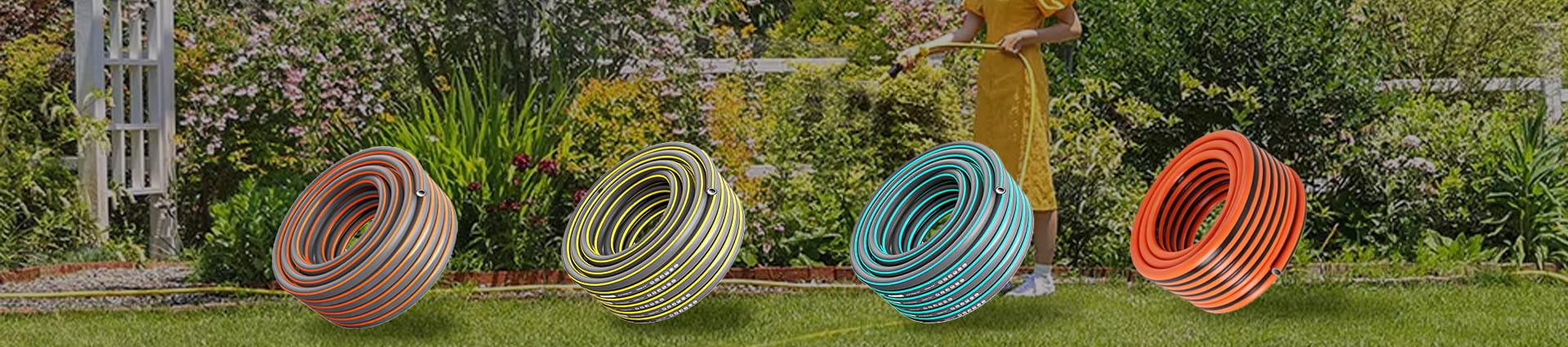
Rubber and PVC Garden Hoses serve different market needs. Rubber hoses provide stronger durability and abrasion resistance, while PVC hoses offer lightweight handling, flexibility, and cost efficiency for general gardening applications.
Material selection is one of the most important decisions when developing a garden hose product line.
For consumers, the choice may appear simple:
Rubber feels stronger
PVC feels lighter
However, professional buyers need to consider the complete product lifecycle.
A hose supplier, distributor, or brand owner must evaluate:
Target customers
Climate conditions
Frequency of use
Required service life
Product positioning
Manufacturing cost
A premium landscaping supplier may need a different hose from a retail gardening brand.
Therefore, the question is not simply:
"Which material is better?"
The real question is:
"Which material matches the intended application?"
Rubber and PVC have different physical characteristics.
Rubber is naturally known for elasticity and toughness.
PVC is widely used because it can be engineered into different levels of flexibility, strength, and cost performance.
The final hose performance depends not only on the base material but also on:
Formulation
Wall thickness
Reinforcement structure
Manufacturing accuracy
Two hoses made from the same material can still perform differently because of production quality.
Rubber hoses are often selected for demanding applications.
Rubber provides strong resistance against:
Abrasion
Repeated bending
Mechanical stress
This makes it suitable for users who frequently move hoses across rough surfaces.
Professional users may require hoses that can withstand:
Long operating periods
Frequent handling
Higher mechanical impact
Rubber construction can provide advantages in these situations.
Depending on formulation, rubber hoses can maintain flexibility under changing temperatures.
This can be valuable in regions with:
Cold winters
Outdoor storage conditions
Seasonal temperature changes
PVC hoses are widely used because they provide balanced performance.
For residential users, hose weight directly affects convenience.
PVC hoses are often easier to:
Carry
Move around gardens
Store after use
For large retail markets, price competitiveness is important.
PVC allows manufacturers to create practical products at accessible price levels.
PVC formulations can be adjusted to achieve different characteristics.
Manufacturers can optimize:
Flexibility
Transparency
Color
Weather resistance
Hardness
This provides more options for different market requirements.
Material alone does not determine hose quality.
The hose structure is equally important.
A typical reinforced garden hose may include:
Inner layer
Reinforcement layer
Outer protective layer
Each layer has a specific function.
The inner layer affects water flow and compatibility.
The reinforcement layer improves pressure resistance.
The outer layer protects against:
UV exposure
Surface damage
Outdoor conditions
A professional manufacturer evaluates the entire structure rather than focusing only on raw material.
PVC hoses are often suitable because users usually prioritize:
Lightweight design
Easy handling
Affordable pricing
Rubber hoses may be preferred when the hose experiences:
Frequent movement
Heavy usage
Rough working conditions
Many brands develop different hose categories because customers have different expectations.
A complete product range may include:
Lightweight garden hoses
Heavy-duty rubber hoses
Reinforced PVC hoses
Professional buyers should evaluate:
A premium product requires different materials and specifications from an entry-level product.
Hose performance can change depending on:
Temperature
UV exposure
Storage environment
A hose for occasional home use does not require the same structure as a commercial landscaping hose.
For private label and wholesale orders, stable production is essential.
The supplier should maintain consistency in:
Diameter
Wall thickness
Color
Flexibility
Pressure performance
Professional hose production involves multiple quality checkpoints.
Manufacturers control:
Raw material formulation
Extrusion temperature
Wall thickness
Reinforcement process
Pressure testing
Aging testing
These factors influence whether the hose can maintain performance after months or years of use.
For international buyers, quality consistency between batches is often more important than a single sample.
Rubber garden hoses are better for heavy-duty applications requiring durability and resistance, while PVC garden hoses are often better for lightweight, cost-effective gardening products.
The correct choice depends on the target market, usage environment, and expected service life.
For hose distributors and private label brands, choosing the correct material structure helps create products that match customer expectations and market positioning.