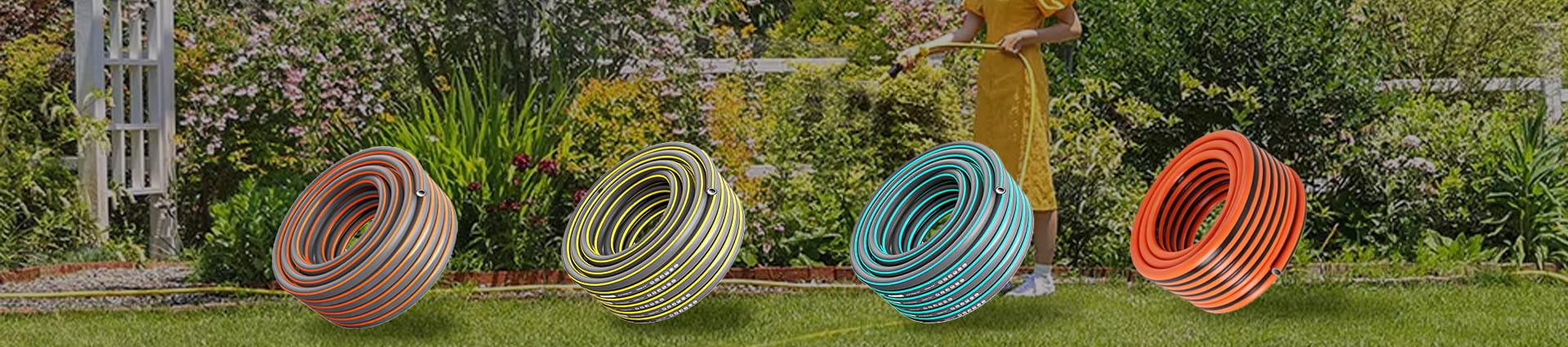
Garden Hoses are used for watering, irrigation, outdoor cleaning, car washing, nursery maintenance, and general facility service. Before buying one, users should evaluate the hose material, diameter, length, pressure rating, flexibility, temperature range, fittings, and storage method.
For importers and distributors, product selection also involves packaging, color, private-label requirements, seasonal demand, and supply consistency. A low purchase price does not always mean lower total cost if the hose kinks easily, leaks at the fittings, or fails after limited use.
PVC is widely used because it offers a balance of flexibility, weight, cost, and customization. PVC hoses can be produced in different colors and structures for household, retail, and general outdoor use.
Reinforced PVC hoses include an additional polyester layer or similar structure to improve pressure performance and dimensional stability. They are often selected for garden watering, car washing, and light commercial applications.
TPE hoses are known for flexibility and a soft handling feel. Depending on the formulation, they may provide cold resistance, aging resistance, and good suitability for repeated outdoor use.
A TPE flexible garden hose can be used for:
Car washing
Gardening
Irrigation
Outdoor cleaning
Household water systems
JITONE supplies TPE hose designs with customized lengths and specifications. One product configuration uses an outside diameter of approximately 14.5 millimeters, an inside diameter of approximately 11.5 millimeters, and a wall thickness of approximately 2 millimeters.
Rubber hoses can provide strong flexibility and resistance for demanding applications, but they are often heavier and more expensive than PVC or TPE alternatives. They may be selected when the user prioritizes rugged handling over lightweight storage.
Hose diameter influences water flow, weight, storage volume, and compatibility with fittings.
A smaller hose is usually lighter and easier to carry. A larger hose can support greater water flow but may require stronger connectors and a larger reel.
Common garden hose sizes include:
1/2 inch for lightweight watering
5/8 inch for general garden use
3/4 inch for higher flow requirements
The connector, nozzle, faucet adapter, and reel should all match the selected diameter. If a buyer combines components from different size systems, leakage or poor water flow may result.
The correct length should cover the working area without creating unnecessary weight or storage difficulty.
A short hose may be suitable for:
Balconies
Small gardens
Patios
Utility rooms
Compact washing areas
Longer hoses may be required for:
Large gardens
Nurseries
Landscaping work
Sports grounds
Hotel outdoor areas
Commercial cleaning stations
JITONE supplies hose lengths that can be customized for different products. Its garden hose reels commonly support lengths such as 10 to 50 meters, while selected high-pressure hose configurations can be produced in longer ranges according to requirements.
For a Bulk Order of garden hoses, buyers should calculate the target market’s common garden sizes and packaging limitations before finalizing the length.
Working pressure indicates the pressure that the hose is designed to handle during normal operation. Burst pressure refers to a higher pressure level used to evaluate failure resistance under test conditions.
A hose should be selected according to actual use:
Household watering
Irrigation
Car washing
Outdoor cleaning
High-pressure spraying
Commercial maintenance
A standard household hose should not be promoted for high-pressure applications without appropriate reinforcement and testing. JITONE offers reinforced PVC hose configurations with specified working and burst pressure options, including models listed at 5 bar working pressure and 15 bar burst pressure, or 7 bar working pressure and 21 bar burst pressure depending on the product.
Kinking can restrict water flow and place stress on the hose wall. It may be caused by:
Insufficient flexibility
Incorrect storage
Sharp bending
Twisting during use
Uneven reinforcement
Poor reel design
Exceeding the recommended bend radius
A hose should be uncoiled before use and stored in wide, even loops. A suitable garden hose holder or reel helps maintain a consistent bend and reduces ground contact.
The fittings are often the first place where users notice leakage. A good hose can still perform poorly if the connector is loose, the tap adapter is incompatible, or the sealing washer is damaged.
Before purchase, check:
Connector size
Faucet compatibility
Brass or plastic material
Quick-connect design
Nozzle connection
Washer quality
Hose grip structure
JITONE supplies brass connectors, ABS connectors, tap adapters, spray nozzles, reels, and complete hose kits. This allows buyers to coordinate the hose and fittings through one garden hose manufacturer and export supplier.
A distributor should evaluate more than technical performance. Product success may also depend on:
Color selection
Retail packaging
Product instructions
Barcode and labeling
Hose reel compatibility
Seasonal demand
Shipping volume
Replacement accessory availability
Repeat-order capacity
For example, a retailer may need green and black connector sets for a standard line, while a private-label brand may request a specific hose color, printed logo, custom carton, and matching nozzle.
JITONE provides OEM and ODM services covering hose diameter, pressure rating, color, reinforcement, printing, and packaging design. Its production system includes extrusion, braiding, winding, assembly, material testing, pressure testing, burst testing, aging evaluation, and batch inspection.
Before selecting a garden hose, answer these questions:
Where will the hose be used?
How far must water travel?
What water pressure is expected?
Is lightweight handling important?
Will the hose be stored on a reel?
Which faucet and nozzle will be connected?
Is the product for household or commercial use?
Does the market require private-label packaging?
Will the buyer need repeated bulk supply?
A Reliable Export Supplier of garden hoses should be able to discuss these details instead of quoting only by length and color.
Before buying a garden hose, evaluate material, diameter, length, pressure, flexibility, fittings, storage, and application. PVC offers broad customization and cost control, reinforced PVC supports stronger pressure performance, and TPE provides a flexible option for gardening, cleaning, irrigation, and car washing.
A complete hose system should include compatible connectors, nozzles, adapters, and storage equipment. JITONE supports wholesalers, importers, retailers, and brand owners with in-house PVC hose production, accessory matching, OEM/ODM customization, quality inspection, and export-ready supply.