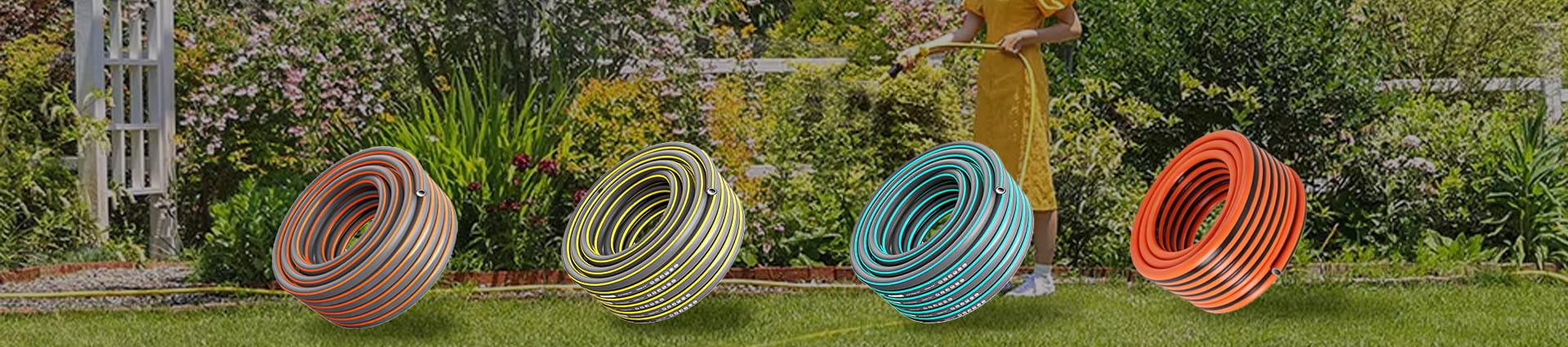
The key differences between high-pressure and low-pressure hoses include reinforcement, wall construction, rated working pressure, fittings, safety requirements, and typical applications. Pressure classification is not determined by hose thickness alone, and the terms “high” and “low” must always be considered in relation to the equipment and relevant specification.
Selecting the wrong category can lead to excessive expansion, leakage, coupling separation, premature wear, or sudden failure.
A low-pressure hose is generally designed for applications where the conveyed medium produces limited internal force. A high-pressure hose uses a stronger engineered structure to contain greater pressure and control dimensional change.
However, a hose does not become a high-pressure product simply because it feels stiff. Verified pressure ratings, compatible materials, reinforcement design, fittings, and test results provide more meaningful evidence.
Low-pressure hoses may use a simpler wall construction, depending on the application. High-pressure hoses normally incorporate reinforcement that carries much of the load generated by internal pressure.
Reinforcement can also help limit expansion and maintain shape. Its design must be balanced with flexibility because an extremely rigid hose can be difficult to route and may transfer stress to fittings.
The working-pressure rating defines normal operational use under specified conditions. Burst testing evaluates the construction under controlled destructive pressure.
Both ratings must be interpreted correctly. The burst value is not a target operating pressure, and safety cannot be assessed by dividing two numbers without considering temperature, pulsation, aging, fittings, and the relevant standard.
Low-pressure water hoses may use relatively simple connectors. High-pressure systems often need carefully matched couplings, seals, thread standards, and assembly processes.
The connection must withstand the same system conditions as the hose. Using a high-pressure hose with an unsuitable fitting does not create a high-pressure assembly.
Low-pressure hose applications can include gravity-fed transfer, drainage, ventilation, and some domestic water tasks. High-pressure hose applications may include:
Agricultural spraying
Industrial and vehicle cleaning
Compressed-air delivery
Pressure equipment
Machinery fluid transfer
Construction and maintenance systems
Application names alone are not sufficient. Two cleaning machines can operate at very different pressures, flow rates, and temperatures.
Failure in a low-pressure line can cause leakage and interruption. Failure in a high-pressure system may release significant energy, making specification, routing, guarding, and inspection especially important.
Operators should never search for a pressurized leak with bare hands. Equipment must be shut down and residual pressure released before inspection or disconnection.
Not automatically. Although the pressure rating may be higher, the replacement could have a different inner diameter, bend radius, weight, fitting style, chemical compatibility, or temperature range.
A smaller inner diameter may restrict flow. A stiffer construction may create routing problems. Different materials may react poorly with the transferred medium. Compatibility must therefore be checked as a system rather than by pressure rating alone.
For distributors and equipment builders, consistent specifications become particularly important when the same hose will be installed across many units. Drawings, approved samples, pressure requirements, fitting details, marking, and inspection criteria should be confirmed before production.
We are a company specializing in PVC hose manufacturing, and we produce multiple high pressure hose solutions for agricultural, cleaning, pneumatic, and industrial use. Our work as a commercial grade High Pressure Hose supplier focuses on matching hose structure to the intended pressure, medium, temperature, routing, and connection requirements.
Our manufacturing system includes extrusion, braiding, winding, and finishing operations. An in-house laboratory carries out pressure, burst, aging, and material tests so that OEM and distributor projects can be evaluated against agreed requirements before shipment.
Rather than relying only on price or appearance, buyers should assess:
Dimensional consistency
Flexibility at the intended temperature
Fitting retention and sealing
Pressure stability
Abrasion resistance
Compatibility with the transferred medium
Printed identification
Coil and packaging quality
The assessment should simulate normal use wherever possible. A hose may perform well in a short static test but behave differently when repeatedly bent, pulsed, dragged, or exposed outdoors.
Share the operating pressure, pressure peaks, fluid, temperature, connection standard, equipment type, and annual demand. Ask our team to compare hose structures for your low-pressure or high-pressure application.